


How to Solve the Springback Control Challenge for High-Strength Steel Stamping Parts in New Energy Vehicles?
Release Time : 2025-11-25
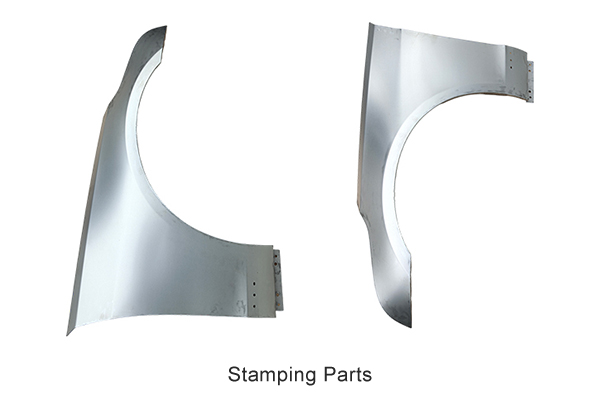
With the dual pursuit of lightweighting and safety performance in new energy vehicles, the application ratio of high-strength steel and advanced high-strength steel in vehicle body structural components continues to rise. However, while these materials offer excellent specific strength, they also significantly exacerbate the springback problem during the stamping process—that is, the part deviates from the target shape after demolding due to elastic recovery. Springback not only affects dimensional accuracy but also leads to difficulties in subsequent welding and assembly, and even reduces the overall vehicle's collision safety. Accurately predicting and effectively controlling the springback of high-strength steel stamping parts has become a key technological bottleneck in the new energy vehicle manufacturing field.
1. Root Cause of Springback: The "Rigidity and Flexibility" Characteristics of High-Strength Steel
The reason why high-strength steel is prone to springback stems from the contradictory characteristics of its high yield strength and low elastic modulus. The higher the yield strength of the material, the greater the load required for forming; however, once the external force is removed, the more elastic strain energy is stored inside, leading to a larger shape rebound. Especially in areas with complex geometric features, uneven stress distribution further amplifies the springback effect. For critical internal panels or structural components commonly found in new energy vehicles, such as battery pack trays, door sill beams, and A/B pillar reinforcement plates, even minute springback deviations can cause assembly interference, directly impacting overall vehicle quality.
2. Simulation-Driven Approach: High-Precision Springback Prediction Lays the Foundation for Process Design
Traditional trial-and-error development methods are time-consuming and costly, making them unsuitable for the rapid iteration demands of new energy vehicle models. Modern stamping processes widely employ high-fidelity CAE simulation technology to predict springback trends before mold design. By introducing material anisotropy models, precise hardening curves, and friction boundary conditions, the simulation system can simulate the stress evolution throughout the entire process from drawing to shaping and trimming. More advanced solutions combine machine learning algorithms to automatically correct material parameters based on historical data, controlling springback prediction errors within ±0.3mm, providing a reliable basis for subsequent compensation.
3. Mold Compensation: From "Experience-Based Mold Repair" to "Digital-Driven"
Based on simulation results, engineers perform reverse compensation on the mold surface—that is, pre-bending it a certain amount in the expected springback direction so that the part springs back to the target shape. Traditional manual mold repair, relying on the experience of master craftsmen, is being replaced by digital compensation processes: CNC machining centers directly reconstruct the mold surface based on compensation data, achieving millimeter-level precision control. For ultra-high-strength steel, some companies are also adopting a "multi-step forming + local pressure" strategy, applying additional constraints in the final forming stage to forcibly suppress elastic recovery.
4. Process Collaboration: Integrated Optimization of Materials, Equipment, and Processes
Springback control is not just a mold issue, but a systems engineering problem. On the one hand, steel mills are collaborating with automakers to develop "low-springback" dedicated high-strength steel, optimizing the elastic modulus and yield strength ratio through micro-alloying and heat treatment processes; on the other hand, the application of servo presses provides new means of process control—their slider motion curves are programmable, implementing "pressure holding delay" or "micro-vibration stress release" at the end of forming, effectively reducing residual stress. Furthermore, integrating laser online measurement systems to the end of the stamping line allows for real-time acquisition of part 3D data and feedback to the mold compensation model, forming a "perception-analysis-correction" closed loop for dynamic quality control.
In today's increasingly competitive new energy vehicle market, the springback control capability of high-strength steel stamping parts directly determines the upper limit of vehicle body precision, assembly efficiency, and safety performance. Only by integrating materials science, intelligent simulation, precision manufacturing, and digital twin technology to build a collaborative springback management system across the entire chain can the lightweight potential of high-strength steel be truly unleashed, allowing "lightweight yet strong" vehicle bodies to move from blueprints to reality and laying a solid safety foundation for green mobility.
1. Root Cause of Springback: The "Rigidity and Flexibility" Characteristics of High-Strength Steel
The reason why high-strength steel is prone to springback stems from the contradictory characteristics of its high yield strength and low elastic modulus. The higher the yield strength of the material, the greater the load required for forming; however, once the external force is removed, the more elastic strain energy is stored inside, leading to a larger shape rebound. Especially in areas with complex geometric features, uneven stress distribution further amplifies the springback effect. For critical internal panels or structural components commonly found in new energy vehicles, such as battery pack trays, door sill beams, and A/B pillar reinforcement plates, even minute springback deviations can cause assembly interference, directly impacting overall vehicle quality.
2. Simulation-Driven Approach: High-Precision Springback Prediction Lays the Foundation for Process Design
Traditional trial-and-error development methods are time-consuming and costly, making them unsuitable for the rapid iteration demands of new energy vehicle models. Modern stamping processes widely employ high-fidelity CAE simulation technology to predict springback trends before mold design. By introducing material anisotropy models, precise hardening curves, and friction boundary conditions, the simulation system can simulate the stress evolution throughout the entire process from drawing to shaping and trimming. More advanced solutions combine machine learning algorithms to automatically correct material parameters based on historical data, controlling springback prediction errors within ±0.3mm, providing a reliable basis for subsequent compensation.
3. Mold Compensation: From "Experience-Based Mold Repair" to "Digital-Driven"
Based on simulation results, engineers perform reverse compensation on the mold surface—that is, pre-bending it a certain amount in the expected springback direction so that the part springs back to the target shape. Traditional manual mold repair, relying on the experience of master craftsmen, is being replaced by digital compensation processes: CNC machining centers directly reconstruct the mold surface based on compensation data, achieving millimeter-level precision control. For ultra-high-strength steel, some companies are also adopting a "multi-step forming + local pressure" strategy, applying additional constraints in the final forming stage to forcibly suppress elastic recovery.
4. Process Collaboration: Integrated Optimization of Materials, Equipment, and Processes
Springback control is not just a mold issue, but a systems engineering problem. On the one hand, steel mills are collaborating with automakers to develop "low-springback" dedicated high-strength steel, optimizing the elastic modulus and yield strength ratio through micro-alloying and heat treatment processes; on the other hand, the application of servo presses provides new means of process control—their slider motion curves are programmable, implementing "pressure holding delay" or "micro-vibration stress release" at the end of forming, effectively reducing residual stress. Furthermore, integrating laser online measurement systems to the end of the stamping line allows for real-time acquisition of part 3D data and feedback to the mold compensation model, forming a "perception-analysis-correction" closed loop for dynamic quality control.
In today's increasingly competitive new energy vehicle market, the springback control capability of high-strength steel stamping parts directly determines the upper limit of vehicle body precision, assembly efficiency, and safety performance. Only by integrating materials science, intelligent simulation, precision manufacturing, and digital twin technology to build a collaborative springback management system across the entire chain can the lightweight potential of high-strength steel be truly unleashed, allowing "lightweight yet strong" vehicle bodies to move from blueprints to reality and laying a solid safety foundation for green mobility.